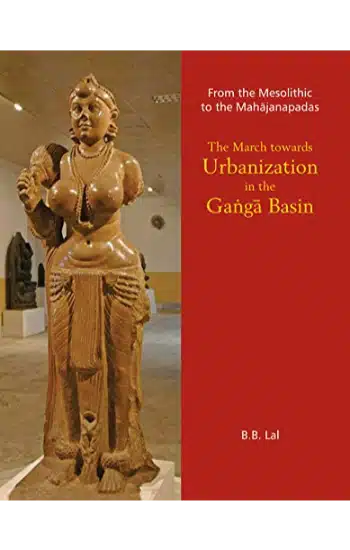
FROM THE MESOLITHIC TO THE MAHAJANAPADAS: THE MARCH TOWARDS URBANIZATION IN THE GANGA BASIN
Publisher:
| Author:
| Language:
| Format:
Publisher:
Author:
Language:
Format:
₹2,950 Original price was: ₹2,950.₹2,360Current price is: ₹2,360.
In stock
Ships within:
In stock
ISBN:
Page Extent:
The 6th-5th centuries before the Common Era witnessed an outburst of urbanization in the Ganga Basin. Cities sprang up with houses built of kiln-fired bricks and oriented along the cardinal directions. Sanitation was taken due care of, with soakage jars, ‘ring wells’ and public drains. Water-supply was ensured by constructing wells and reservoirs.
Surplus agricultural produce and storage thereof in granaries testified to basic economic health. Trade was in full swing and there were long-distance trade-routes, such as Uttarapatha and Daksinapatha. Systems of weights and coinage emerged and that of writing was not left behind.
All this coincided with the emergence of Sodasa Mahajanapadas (Sixteen Big States), which throws light on the contemporary political set-up. Matrimonial alliances on the one hand and wars on the other became common features. A striking point about the Ganga Civilization is that whereas the Harappan Civilization was confined to the north-western part of India, this civilization covered the entire sub-continent -from Pakistan to Bangladesh and down south even to Sri Lanka.
But, as they say, ‘Rome was not built in a day’. It took four millennia for the Ganga Civilization to evolve from a Neolithic base in the 4th millennium BCE. On this foundation impinged a chalcolithic culture, followed by the emergence of iron. Signs of an incipient urbanization began to appear with the Painted Grey Ware Culture towards the end of 2nd millennium BCE. The book deals with this ‘march towards urbanization’ in the Ganga basin.

The 6th-5th centuries before the Common Era witnessed an outburst of urbanization in the Ganga Basin. Cities sprang up with houses built of kiln-fired bricks and oriented along the cardinal directions. Sanitation was taken due care of, with soakage jars, ‘ring wells’ and public drains. Water-supply was ensured by constructing wells and reservoirs.
Surplus agricultural produce and storage thereof in granaries testified to basic economic health. Trade was in full swing and there were long-distance trade-routes, such as Uttarapatha and Daksinapatha. Systems of weights and coinage emerged and that of writing was not left behind.
All this coincided with the emergence of Sodasa Mahajanapadas (Sixteen Big States), which throws light on the contemporary political set-up. Matrimonial alliances on the one hand and wars on the other became common features. A striking point about the Ganga Civilization is that whereas the Harappan Civilization was confined to the north-western part of India, this civilization covered the entire sub-continent -from Pakistan to Bangladesh and down south even to Sri Lanka.
But, as they say, ‘Rome was not built in a day’. It took four millennia for the Ganga Civilization to evolve from a Neolithic base in the 4th millennium BCE. On this foundation impinged a chalcolithic culture, followed by the emergence of iron. Signs of an incipient urbanization began to appear with the Painted Grey Ware Culture towards the end of 2nd millennium BCE. The book deals with this ‘march towards urbanization’ in the Ganga basin.
About Author
Reviews
There are no reviews yet.

Reviews
There are no reviews yet.