Some Hindu Beliefs for the Young
Some Hindu Beliefs for the Young Original price was: ₹399.Current price is: ₹359.
Back to products
A gentle introduction to Carnatic Music
A gentle introduction to Carnatic Music Original price was: ₹199.Current price is: ₹198.

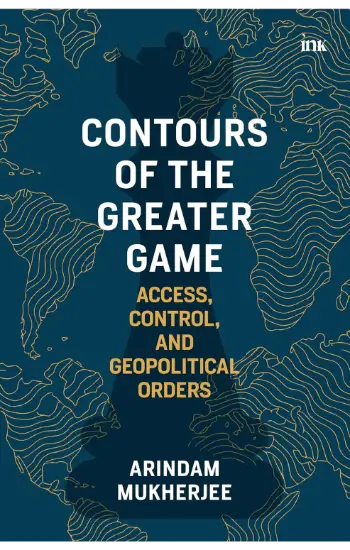
Contours of the Greater Game: Access, Control, and Geopolitical Orders

Publisher:
BluOne Ink Pvt Ltd
| Author:
Arindam Mukherjee
| Language:
English
| Format:
Hardback
Publisher:
BluOne Ink Pvt Ltd
Author:
Arindam Mukherjee
Language:
English
Format:
Hardback

Original price was: ₹899.Current price is: ₹809.

In stock

Ships within:
7-10 Days

In stock

ISBN:
Category:
Page Extent:
320

Global geopolitics has always revolved around two core principles: access and control. Institutions like the UN, IMF, and World Bank, or alternative blocs such as the SCO and BRICS, even the persistent narrative of West versus the rest, are all different expressions of the same fundamental struggle. Beneath the structures and alliances lie the ambition of competing powers to assert supremacy. This is the Greater Game.

We’ve long been led to believe that there was only one Great Game: the storied Anglo–Russian rivalry that unfolded across Asia. We’ve been told it was exceptional, and that it has ended. Contours of the Greater Game challenges that narrative. It argues that the label ‘great’ not only romanticized the conflict but also diverted our attention from other geopolitical rivalries of equal or even greater consequence that have emerged in its wake.

As India steps onto the ‘Grand Chessboard’ of global politics, the book seeks to unpack the deeper forces shaping this moment. It begins by examining the minds and strategic thinkings of those who first framed the idea of access: the drive to reach, influence, and exploit regions of economic or strategic value. It then turns to the mechanisms of control: how practices like religion, democracy, and globalization have been deployed to maintain dominance once access is secured. The book also explores the various regional and global orders that have arisen under these dynamics, revealing how power is structured and reshaped over time.

Ultimately, it looks ahead—at India’s positioning within this complex and evolving web of global geopolitics. What role can, or should, India play in this renewed contest for influence and control?

To grasp the present and anticipate the future, readers must understand the origins and mechanics of the Greater Game. Only those who know the game can hope to shape its outcome. Access and control are the centrifugal and centripetal forces, respectively, that drive global power struggles. Whether through global institutions or rival coalitions, nations pursue influence under evolving banners.

Contours of the Greater Game dismantles the myth that geopolitical rivalry ended with the famed Anglo–Russian standoff. It argues, instead, that newer contests—often overlooked—have taken its place.

As India asserts itself on the world stage, the book delves into the historical logic of expansion and the instruments—ideology, governance, and global systems—used to entrench control. It asks how India might engage with this intricate geopolitical contest, and whether understanding the game offers a path to shaping it.

Reviews

There are no reviews yet.

Be the first to review “Contours of the Greater Game: Access, Control, and Geopolitical Orders”

Your email address will not be published. Required fields are marked *

Description

Global geopolitics has always revolved around two core principles: access and control. Institutions like the UN, IMF, and World Bank, or alternative blocs such as the SCO and BRICS, even the persistent narrative of West versus the rest, are all different expressions of the same fundamental struggle. Beneath the structures and alliances lie the ambition of competing powers to assert supremacy. This is the Greater Game.

We’ve long been led to believe that there was only one Great Game: the storied Anglo–Russian rivalry that unfolded across Asia. We’ve been told it was exceptional, and that it has ended. Contours of the Greater Game challenges that narrative. It argues that the label ‘great’ not only romanticized the conflict but also diverted our attention from other geopolitical rivalries of equal or even greater consequence that have emerged in its wake.

As India steps onto the ‘Grand Chessboard’ of global politics, the book seeks to unpack the deeper forces shaping this moment. It begins by examining the minds and strategic thinkings of those who first framed the idea of access: the drive to reach, influence, and exploit regions of economic or strategic value. It then turns to the mechanisms of control: how practices like religion, democracy, and globalization have been deployed to maintain dominance once access is secured. The book also explores the various regional and global orders that have arisen under these dynamics, revealing how power is structured and reshaped over time.

Ultimately, it looks ahead—at India’s positioning within this complex and evolving web of global geopolitics. What role can, or should, India play in this renewed contest for influence and control?

To grasp the present and anticipate the future, readers must understand the origins and mechanics of the Greater Game. Only those who know the game can hope to shape its outcome. Access and control are the centrifugal and centripetal forces, respectively, that drive global power struggles. Whether through global institutions or rival coalitions, nations pursue influence under evolving banners.

Contours of the Greater Game dismantles the myth that geopolitical rivalry ended with the famed Anglo–Russian standoff. It argues, instead, that newer contests—often overlooked—have taken its place.

As India asserts itself on the world stage, the book delves into the historical logic of expansion and the instruments—ideology, governance, and global systems—used to entrench control. It asks how India might engage with this intricate geopolitical contest, and whether understanding the game offers a path to shaping it.

About Author

Arindam Mukherjee is the author of A Matter of Greed, a geopolitical analysis exploring the West’s pursuit of power through greed and its far-reaching impact on the rest of the world. He is also the author of the political thriller The Puppeteer and a short story collection titled Journey Dog Tales. In addition, he has translated and adapted the fantasy-adventure Sambhala: The Journey Begins, originally written by Bengali author Shariful Hassan. Arindam has over two decades of corporate experience, having worked across consumer and consulting sectors in both Indian and international markets. Today, his professional focus lies in human resources and learning & development (L&D) consulting, where he continues to engage with organizations in a strategic advisory capacity. A ‘geopolitical enthusiast’, as he likes to call himself, Arindam is a contributing columnist for ForPol, The New Indian, and Firstpost; his X handle is heartland_ari.

Reviews

There are no reviews yet.

Be the first to review “Contours of the Greater Game: Access, Control, and Geopolitical Orders”

Your email address will not be published. Required fields are marked *

[wt-related-products product_id="test001"]

RELATED PRODUCTS

RECENTLY VIEWED