How Maritime Trade And The Indian Subcontinent Sharped The Word: Ice Age to Mid-Eighth Century
How Maritime Trade And The Indian Subcontinent Sharped The Word: Ice Age to Mid-Eighth Century Original price was: ₹699.Current price is: ₹559.
Back to products
Roads To Progress A Visionary Architect of Modern India Nitin Gadkari
Roads To Progress A Visionary Architect of Modern India Nitin Gadkari Original price was: ₹699.Current price is: ₹559.

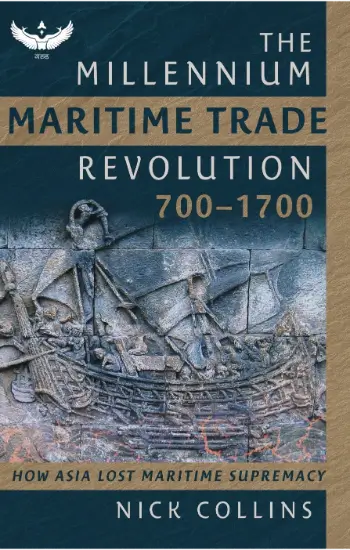
The Millennium Maritime Trade Revolution 700-1700: How Asia Lost Maritime Supremacy

Publisher:
Garuda Prakashan
| Author:
Nick Collins
| Language:
English
| Format:
Paperback
Publisher:
Garuda Prakashan
Author:
Nick Collins
Language:
English
Format:
Paperback

Original price was: ₹699.Current price is: ₹559.

In stock

Ships within:
7-10 Days

In stock

ISBN:
Categories: ,
Page Extent:
362

Following the series’ first book How Maritime Trade and the Indian Subcontinent Shaped the World, this book continues to demonstrate how maritime trade has been the key driver of the world’s wealth-creation, economic and intellectual progress. The story begins where the first book ends, when following Roman Empire collapse, 7th-century European maritime trade almost ceased, creating population collapse and poverty; the Dark Ages. In 700 stuttering, hesitant recovery was evident with new ports but Viking and Muslim maritime raiding neutered recovery until the 11th century. In Asia by contrast, short and long-haul trade thrived and accelerated from east Africa and the Persian Gulf all the way to China, encouraging Southeast Asian state formation. The book tells the story of slowly rising, gradually accelerating European maritime trade, which until the 15th century was overshadowed by far more voluminous Asian trade in much larger, more complex ships traded by more sophisticated commercial entities, contributing to innovative tolerant wealth-creating maritime societies. In Europe, Mediterranean maritime trade made most progress from about 1000 to 1450,. But by 1700 north Europeans dominated Atlantic, American and Mediterranean trade and were penetrating sophisticated Asian maritime networks, a complete reversal. This book explains how and why and how destructive continental influences destroyed Asia’s maritime supremacy. As in the first book, Nick Collins finds similar patterns; maritime inquisitiveness, invention, problem-solving and toleration and continental political suppression of those maritime traits, most dramatically in China, but destructively everywhere, allowing the millennium maritime trade revolution.

Nick collins read history at Magdalene College Cambridge, thereafter pursuing a career in maritime trade, becoming a director of H. Clarkson and Co, the world’s largest shipping services company and various subsidiaries, including MD and CEO in Singapore, COO in Dubai and wrote The Essential Guide to Chartering and the Dry Freight Market. He has done business throughout the world, advising many large companies and brings practical knowledge and experience to academic research, to produce a unique work.

Reviews

There are no reviews yet.

Be the first to review “The Millennium Maritime Trade Revolution 700-1700: How Asia Lost Maritime Supremacy”

Your email address will not be published. Required fields are marked *

Description

Following the series’ first book How Maritime Trade and the Indian Subcontinent Shaped the World, this book continues to demonstrate how maritime trade has been the key driver of the world’s wealth-creation, economic and intellectual progress. The story begins where the first book ends, when following Roman Empire collapse, 7th-century European maritime trade almost ceased, creating population collapse and poverty; the Dark Ages. In 700 stuttering, hesitant recovery was evident with new ports but Viking and Muslim maritime raiding neutered recovery until the 11th century. In Asia by contrast, short and long-haul trade thrived and accelerated from east Africa and the Persian Gulf all the way to China, encouraging Southeast Asian state formation. The book tells the story of slowly rising, gradually accelerating European maritime trade, which until the 15th century was overshadowed by far more voluminous Asian trade in much larger, more complex ships traded by more sophisticated commercial entities, contributing to innovative tolerant wealth-creating maritime societies. In Europe, Mediterranean maritime trade made most progress from about 1000 to 1450,. But by 1700 north Europeans dominated Atlantic, American and Mediterranean trade and were penetrating sophisticated Asian maritime networks, a complete reversal. This book explains how and why and how destructive continental influences destroyed Asia’s maritime supremacy. As in the first book, Nick Collins finds similar patterns; maritime inquisitiveness, invention, problem-solving and toleration and continental political suppression of those maritime traits, most dramatically in China, but destructively everywhere, allowing the millennium maritime trade revolution.

Nick collins read history at Magdalene College Cambridge, thereafter pursuing a career in maritime trade, becoming a director of H. Clarkson and Co, the world’s largest shipping services company and various subsidiaries, including MD and CEO in Singapore, COO in Dubai and wrote The Essential Guide to Chartering and the Dry Freight Market. He has done business throughout the world, advising many large companies and brings practical knowledge and experience to academic research, to produce a unique work.

About Author

Reviews

There are no reviews yet.

Be the first to review “The Millennium Maritime Trade Revolution 700-1700: How Asia Lost Maritime Supremacy”

Your email address will not be published. Required fields are marked *

[wt-related-products product_id="test001"]

RELATED PRODUCTS

RECENTLY VIEWED