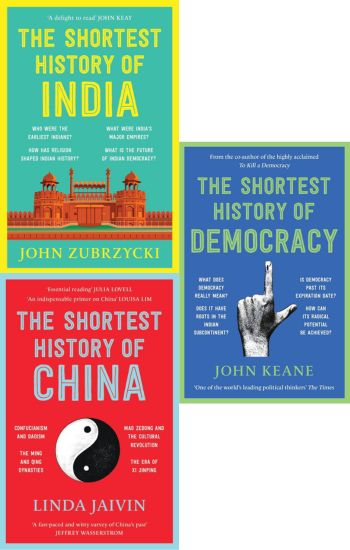
Combo of 3 Shortest History Books : The Shortest History of India | The Shortest History of China | The Shortest History of Democracy
Publisher:
| Author:
| Language:
| Format:
Publisher:
Author:
Language:
Format:
₹1,697 Original price was: ₹1,697.₹1,272Current price is: ₹1,272.
In stock
Ships within:
In stock
ISBN:
Page Extent:
1. The Shortest History of India :-
5,000 YEARS OF INDIAN HISTORY IN LESS THAN 300 PAGES
From the ruins of ancient civilisations to an emerging global superpower
One of the oldest civilisations and the largest democracy in the world, India is an amalgam of customs, races, castes, languages and spiritual beliefs, woven together over 5,000 years of wonderfully colossal and chaotic history.
From the earliest humans and the Harappan civilisation to Muslim conquerors, the Great Mughals, British rule, the country’s struggle for autonomy and present-day hopes and challenges, John Zubrzycki masterfully condenses five millennia of deities, mutinies, wars, great empires, decadent dynasties, invasions, migrations, colonisation and independence into a fascinating, lively telling. He brings the complex and contrasting layers of Indian history to life through a well-known cast of characters – Buddha, Alexander the Great, Akbar, Clive, Tipu Sultan, Lakshmi Bai, Curzon, Jinnah, Mahatma Gandhi – against a backdrop of the ever-present Ganges, the desert forts of Rajasthan, the snow-covered Himalayas and the ruins of India’s fabled civilisations.
From medicine to mathematics, philosophy to astronomy, literature to music, Buddhism to Bollywood, India has made its mark on Asia and the world. Its progress in tackling poverty and illiteracy have been impressive, but extraordinary challenges remain – not least the threat to its secular, democratic fabric. Only time will tell if India can overcome its political, social and religious tensions to rise again and become the next global superpower.
2. The Shortest History of China :-
From kung-fu to tofu, tea to trade routes, sages to silk, China has inf luenced cuisine, commerce, military strategy, aesthetics and philosophy across the world for thousands of years. Chinese history is sprawling and gloriously messy. It is full of heroes who are also villains, prosperous ages and violent rebellions, cultural vibrancy and censorious impulses, loyalists, dissidents and wits. The story of women in China, from the earliest warriors to twentieth century suffragettes, is rarely told. And historical spectres of corruption and disunity, which have brought down many a mighty ruling house, continue to haunt the People’s Republic today. Modern China is seen variously as an economic powerhouse, an icon of urbanisation, a propaganda state or an aggressive superpower seeking world domination. Linda Jaivin distils a vast history into a short, readable account that tells you what you need to know, from China’s philosophical origins to its political system, to the COVID-19 pandemic and where the PRC is likely to lead the world.
3. The Shortest History of Democracy :-
A bold new history of democracy from the popular assemblies of Syria-Mesopotamia and the Indian subcontinent to present-day challenges around the world.
From its beginnings in Syria-Mesopotamia and the Indian subcontinent to its role in fomenting revolutionary fervour in France and America, democracy has subverted fixed ways of deciding who should enjoy power and privilege, and why. For democracy encourages people to do something radical: to come together as equals, to determine their own lives and futures.
In this vigorous, illuminating history, acclaimed political thinker John Keane traces its byzantine history, from the age of assembly democracy in Athens, to European-inspired electoral democracy and the birth of representative government, to our age of monitory democracy. He gives new reasons why democracy is a precious global ideal, and shows that as the world has come to be shaped by democracy, it has grown more worldly.
In today’s age of populist strongmen threatening democracy in India, China, Russia, Saudi Arabia, the US and elsewhere, we need its radical potential more than ever. Does democracy have a future, or will the demagogues and despots win? We are about to find out.
1. The Shortest History of India :-
5,000 YEARS OF INDIAN HISTORY IN LESS THAN 300 PAGES
From the ruins of ancient civilisations to an emerging global superpower
One of the oldest civilisations and the largest democracy in the world, India is an amalgam of customs, races, castes, languages and spiritual beliefs, woven together over 5,000 years of wonderfully colossal and chaotic history.
From the earliest humans and the Harappan civilisation to Muslim conquerors, the Great Mughals, British rule, the country’s struggle for autonomy and present-day hopes and challenges, John Zubrzycki masterfully condenses five millennia of deities, mutinies, wars, great empires, decadent dynasties, invasions, migrations, colonisation and independence into a fascinating, lively telling. He brings the complex and contrasting layers of Indian history to life through a well-known cast of characters – Buddha, Alexander the Great, Akbar, Clive, Tipu Sultan, Lakshmi Bai, Curzon, Jinnah, Mahatma Gandhi – against a backdrop of the ever-present Ganges, the desert forts of Rajasthan, the snow-covered Himalayas and the ruins of India’s fabled civilisations.
From medicine to mathematics, philosophy to astronomy, literature to music, Buddhism to Bollywood, India has made its mark on Asia and the world. Its progress in tackling poverty and illiteracy have been impressive, but extraordinary challenges remain – not least the threat to its secular, democratic fabric. Only time will tell if India can overcome its political, social and religious tensions to rise again and become the next global superpower.
2. The Shortest History of China :-
From kung-fu to tofu, tea to trade routes, sages to silk, China has inf luenced cuisine, commerce, military strategy, aesthetics and philosophy across the world for thousands of years. Chinese history is sprawling and gloriously messy. It is full of heroes who are also villains, prosperous ages and violent rebellions, cultural vibrancy and censorious impulses, loyalists, dissidents and wits. The story of women in China, from the earliest warriors to twentieth century suffragettes, is rarely told. And historical spectres of corruption and disunity, which have brought down many a mighty ruling house, continue to haunt the People’s Republic today. Modern China is seen variously as an economic powerhouse, an icon of urbanisation, a propaganda state or an aggressive superpower seeking world domination. Linda Jaivin distils a vast history into a short, readable account that tells you what you need to know, from China’s philosophical origins to its political system, to the COVID-19 pandemic and where the PRC is likely to lead the world.
3. The Shortest History of Democracy :-
A bold new history of democracy from the popular assemblies of Syria-Mesopotamia and the Indian subcontinent to present-day challenges around the world.
From its beginnings in Syria-Mesopotamia and the Indian subcontinent to its role in fomenting revolutionary fervour in France and America, democracy has subverted fixed ways of deciding who should enjoy power and privilege, and why. For democracy encourages people to do something radical: to come together as equals, to determine their own lives and futures.
In this vigorous, illuminating history, acclaimed political thinker John Keane traces its byzantine history, from the age of assembly democracy in Athens, to European-inspired electoral democracy and the birth of representative government, to our age of monitory democracy. He gives new reasons why democracy is a precious global ideal, and shows that as the world has come to be shaped by democracy, it has grown more worldly.
In today’s age of populist strongmen threatening democracy in India, China, Russia, Saudi Arabia, the US and elsewhere, we need its radical potential more than ever. Does democracy have a future, or will the demagogues and despots win? We are about to find out.
About Author
Linda Jaivin is an American-born, internationally published Australian essayist, novelist, translator, and specialist writer on China. Her books include The Monkey and the Dragon, the city profile Beijing, and several China-based novels. Her essays have appeared in a wide range of publications in Australia and beyond. She has previously lived, studied, and worked in Taiwan, Hong Kong, and Beijing.
John Keane is currently Professor of Politics at the University of Sydney and the WZB (Berlin). He is the author of many acclaimed books, most recently The New Despotism (2020) and To Kill A Democracy: India’s Passage To Despotism (2021, with Debasish Roy Chowdhury).
Reviews
There are no reviews yet.

Reviews
There are no reviews yet.