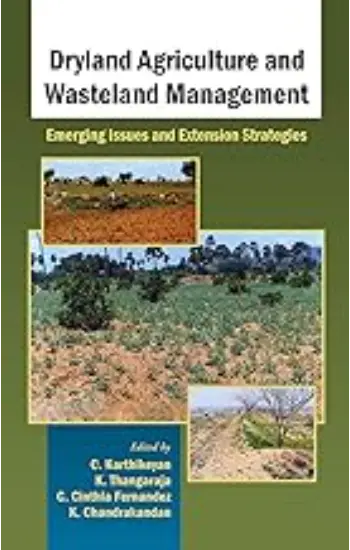
Dryland Agriculture And Wasteland Management: Emerging Issues And Extension Strategies
Publisher:
| Author:
| Language:
| Format:
Publisher:
Author:
Language:
Format:
₹595 Original price was: ₹595.₹476Current price is: ₹476.
In stock
Ships within:
In stock
ISBN:
Page Extent:
Indian agriculture is predominantly rainfed under which both dry farming and dryland agriculture are included. Out of the total 143 million ha of cultivated area in the country, 101 million ha, i.e. nearly 70 per cent is rainfed. The dryland areas of the country contribute about 42 per cent of the total foodgrain production. In order to meet the targeted foodgrain production of 240 million tonnes, production from drylands has to be increased to 60 per cent.
Dryland agriculture in India is always a challenge, since crop production in dryland areas depends on monsoon showers. The major concerns of dryland farmers are: unpredictability of onset, duration and distribution of rainfall; unfavourable crop growth environment; limited choice of crop varieties; low fertility of soils; and short growing seasons.
There is an urgent need to formulate strategies to improve agriculture production in the dry farming tracts. Some improved techniques and practices recommended by experts include using resistant, tolerant, high-yielding and short-duration crop varieties; observing weather conditions closely and planning farming activities accordingly; and exercising substitution in favour of those crops which are efficient utilizers of moisture and more responsive to inputs.
Dryland Agriculture and Wasteland Management: Emerging Issues and Extension Strategies is an anthology of well-researched articles by scientists, scholars and researchers on pertinent topics related to dryland agriculture such as wasteland management, soil evaluation, farming systems, extension strategies, indigenous technical knowledge, watershed management and sustainability of farming in different areas.
The book will prove to be an ideal reference source for students, teachers, researchers, administrators and all those concerned with the development of dryland agriculture in India.

Indian agriculture is predominantly rainfed under which both dry farming and dryland agriculture are included. Out of the total 143 million ha of cultivated area in the country, 101 million ha, i.e. nearly 70 per cent is rainfed. The dryland areas of the country contribute about 42 per cent of the total foodgrain production. In order to meet the targeted foodgrain production of 240 million tonnes, production from drylands has to be increased to 60 per cent.
Dryland agriculture in India is always a challenge, since crop production in dryland areas depends on monsoon showers. The major concerns of dryland farmers are: unpredictability of onset, duration and distribution of rainfall; unfavourable crop growth environment; limited choice of crop varieties; low fertility of soils; and short growing seasons.
There is an urgent need to formulate strategies to improve agriculture production in the dry farming tracts. Some improved techniques and practices recommended by experts include using resistant, tolerant, high-yielding and short-duration crop varieties; observing weather conditions closely and planning farming activities accordingly; and exercising substitution in favour of those crops which are efficient utilizers of moisture and more responsive to inputs.
Dryland Agriculture and Wasteland Management: Emerging Issues and Extension Strategies is an anthology of well-researched articles by scientists, scholars and researchers on pertinent topics related to dryland agriculture such as wasteland management, soil evaluation, farming systems, extension strategies, indigenous technical knowledge, watershed management and sustainability of farming in different areas.
The book will prove to be an ideal reference source for students, teachers, researchers, administrators and all those concerned with the development of dryland agriculture in India.
About Author
Reviews
There are no reviews yet.

Reviews
There are no reviews yet.