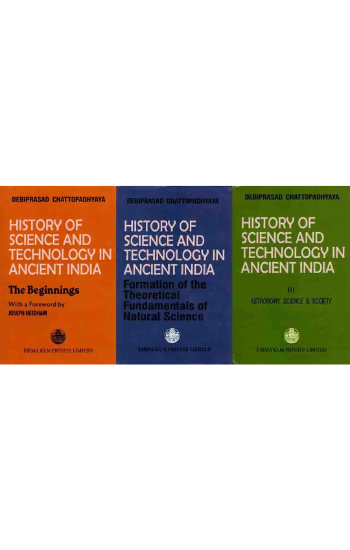
History of Science and Technology in Ancient India (Set of 3 Volumes)
Publisher:
| Author:
| Language:
| Format:
Publisher:
Author:
Language:
Format:
₹3,599 Original price was: ₹3,599.₹3,598Current price is: ₹3,598.
In stock
Ships within:
In stock
ISBN:
Page Extent:
History of Science and Technology in Ancient India (Set of 3 Volumes) by Debiprasad Chattopadhyaya is a monumental work that explores the scientific and technological achievements of India’s ancient civilization. Written by one of India’s foremost philosophers and historians of ideas, this set is widely regarded as a pioneering attempt to systematize the study of India’s intellectual and material contributions to the world.
Across the three volumes, Chattopadhyaya examines how science and technology evolved in India from early times through successive phases of history. He delves into disciplines such as mathematics, astronomy, metallurgy, medicine, agriculture, and architecture, highlighting not only the discoveries and innovations but also their social context. What makes this work significant is its methodological approach — instead of treating ancient science as isolated marvels, the author places them within the broader dynamics of society, economy, and culture.
The study pays particular attention to texts like the Rigveda, Ayurvedic Samhitas, Susruta and Charaka, mathematical works of Aryabhata and Bhaskaracharya, and technological references in the Arthashastra and other sources. By analyzing these, Chattopadhyaya reconstructs a narrative of India’s scientific tradition that is rational, progressive, and deeply rooted in material practices of ancient communities.
This set is not only a historical account but also a critical response to two extremes: the colonial dismissal of India’s scientific past and the uncritical glorification of it. Chattopadhyaya emphasizes a balanced view — recognizing the real achievements while also pointing out the limitations imposed by social and economic conditions of the time.
As an old and rare collection, this three-volume set remains indispensable for students, researchers, and readers interested in the history of ideas, philosophy of science, and the cultural heritage of India. It continues to inspire critical inquiry into how ancient knowledge systems shaped the trajectory of Indian civilization.

History of Science and Technology in Ancient India (Set of 3 Volumes) by Debiprasad Chattopadhyaya is a monumental work that explores the scientific and technological achievements of India’s ancient civilization. Written by one of India’s foremost philosophers and historians of ideas, this set is widely regarded as a pioneering attempt to systematize the study of India’s intellectual and material contributions to the world.
Across the three volumes, Chattopadhyaya examines how science and technology evolved in India from early times through successive phases of history. He delves into disciplines such as mathematics, astronomy, metallurgy, medicine, agriculture, and architecture, highlighting not only the discoveries and innovations but also their social context. What makes this work significant is its methodological approach — instead of treating ancient science as isolated marvels, the author places them within the broader dynamics of society, economy, and culture.
The study pays particular attention to texts like the Rigveda, Ayurvedic Samhitas, Susruta and Charaka, mathematical works of Aryabhata and Bhaskaracharya, and technological references in the Arthashastra and other sources. By analyzing these, Chattopadhyaya reconstructs a narrative of India’s scientific tradition that is rational, progressive, and deeply rooted in material practices of ancient communities.
This set is not only a historical account but also a critical response to two extremes: the colonial dismissal of India’s scientific past and the uncritical glorification of it. Chattopadhyaya emphasizes a balanced view — recognizing the real achievements while also pointing out the limitations imposed by social and economic conditions of the time.
As an old and rare collection, this three-volume set remains indispensable for students, researchers, and readers interested in the history of ideas, philosophy of science, and the cultural heritage of India. It continues to inspire critical inquiry into how ancient knowledge systems shaped the trajectory of Indian civilization.
About Author
Reviews
There are no reviews yet.

Reviews
There are no reviews yet.