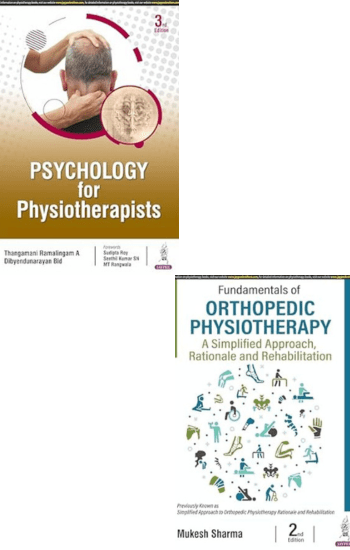
Set of 2 Books: Psychology For Physiotherapists | Fundamentals of Orthopedic Physiotherapy: A Simplified Approach, Rationale and Rehabilitation
Publisher:
| Author:
| Language:
| Format:
Publisher:
Author:
Language:
Format:
₹1,290 Original price was: ₹1,290.₹1,096Current price is: ₹1,096.
In stock
Ships within:
In stock
ISBN:
Page Extent:
1. Psychology For Physiotherapists:
This book reflects the need for an integral approach to physiotherapy. It is a book that can be used as a reference by physiotherapy undergraduate and postgraduate students, researchers, academicians, and clinical physiotherapists. The book aims at developing clinical reasoning and problem-solving approaches in treating various orthopedic conditions as well as providing a theoretical base.
This book also seeks to teach the fundamental approach to physiotherapy practice so that the diagnosis and physiotherapy treatment are merged into an established pattern. It elaborates the detailed information of all the possible musculoskeletal conditions with their pathophysiology, symptoms, epidemiology, assessment, and diagnosis, along with their surgical and nonsurgical management based on current rationale. This book includes the most accepted established exercise protocol, which is an important way to provide evidence-based practice.
2. Fundamentals of Orthopedic Physiotherapy: A Simpli_ed Approach, Rationale and Rehabilitation:
It is a classical textbook on orthopedic physiotherapy and rehabilitation that is drafted to satisfy the quest for knowledge on clinical orthopedicThis book is a valuable resource for bridging the gap between psychology and physiotherapy. The comprehensive content of this book is a testament to the authors’ deep understanding of both fields. Their combined expertise is evident in the way complex psychological concepts are presented in a manner that is both accessible and relevant to physiotherapy students and practitioners.
From fundamental topics like sensation, perception, and motivation to more specialized areas such as stress, pain management, and the psychology of chronic terminal illness, this book covers a broad spectrum of psychological knowledge that is essential for modern physiotherapy practice. One of the book’s strengths is its practical approach, with chapters dedicated to psychological testing, health communication, cognitive behavior therapy, and relaxation methods
Key Features: 1. The book is primarily written for the Physiotherapy students.
2. Fundamentals of Orthopedic Physiotherapy: A Simplified Approach, Rationale and Rehabilitation
This psychology textbook highlights the following content:
3. Foundations of Psychology: Comprehensive exploration of core psychological concepts, including sensation, perception, learning, memory, and intelligence, essential for understanding human behavior
4. Emotional and Social Dynamics: Detailed insights into emotions, stress, frustration, defense mechanisms, personality, and social psychology, helping students address the mental and emotional aspects of patient rehabilitation
5. Therapies and Interventions: Overview of various psychotherapies, relaxation techniques, and cognitive–behavioral methods designed to support patients with chronic illnesses, psychological disorders, and terminal conditions
6. Practical Tools and Assessments: Guidance on psychological testing, research methods, health communication, and the application of psychophysiotherapy, equipping students with skills for effective psychological assessments in clinical settings.

1. Psychology For Physiotherapists:
This book reflects the need for an integral approach to physiotherapy. It is a book that can be used as a reference by physiotherapy undergraduate and postgraduate students, researchers, academicians, and clinical physiotherapists. The book aims at developing clinical reasoning and problem-solving approaches in treating various orthopedic conditions as well as providing a theoretical base.
This book also seeks to teach the fundamental approach to physiotherapy practice so that the diagnosis and physiotherapy treatment are merged into an established pattern. It elaborates the detailed information of all the possible musculoskeletal conditions with their pathophysiology, symptoms, epidemiology, assessment, and diagnosis, along with their surgical and nonsurgical management based on current rationale. This book includes the most accepted established exercise protocol, which is an important way to provide evidence-based practice.
2. Fundamentals of Orthopedic Physiotherapy: A Simpli_ed Approach, Rationale and Rehabilitation:
It is a classical textbook on orthopedic physiotherapy and rehabilitation that is drafted to satisfy the quest for knowledge on clinical orthopedicThis book is a valuable resource for bridging the gap between psychology and physiotherapy. The comprehensive content of this book is a testament to the authors’ deep understanding of both fields. Their combined expertise is evident in the way complex psychological concepts are presented in a manner that is both accessible and relevant to physiotherapy students and practitioners.
From fundamental topics like sensation, perception, and motivation to more specialized areas such as stress, pain management, and the psychology of chronic terminal illness, this book covers a broad spectrum of psychological knowledge that is essential for modern physiotherapy practice. One of the book’s strengths is its practical approach, with chapters dedicated to psychological testing, health communication, cognitive behavior therapy, and relaxation methods
Key Features: 1. The book is primarily written for the Physiotherapy students.
2. Fundamentals of Orthopedic Physiotherapy: A Simplified Approach, Rationale and Rehabilitation
This psychology textbook highlights the following content:
3. Foundations of Psychology: Comprehensive exploration of core psychological concepts, including sensation, perception, learning, memory, and intelligence, essential for understanding human behavior
4. Emotional and Social Dynamics: Detailed insights into emotions, stress, frustration, defense mechanisms, personality, and social psychology, helping students address the mental and emotional aspects of patient rehabilitation
5. Therapies and Interventions: Overview of various psychotherapies, relaxation techniques, and cognitive–behavioral methods designed to support patients with chronic illnesses, psychological disorders, and terminal conditions
6. Practical Tools and Assessments: Guidance on psychological testing, research methods, health communication, and the application of psychophysiotherapy, equipping students with skills for effective psychological assessments in clinical settings.
About Author
Reviews
There are no reviews yet.

Reviews
There are no reviews yet.