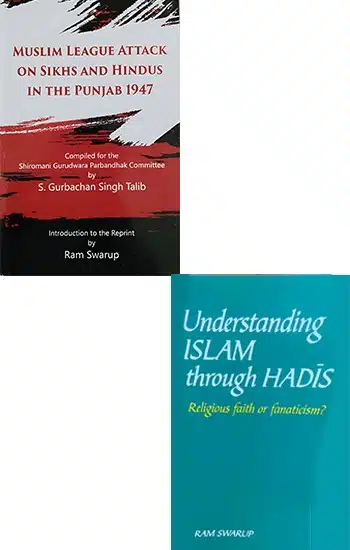
Set Of 2 Books : Understanding ISLAM through HADIS I Muslim League Attack on Sikhs and Hindus in the Punjab 1947
Publisher:
| Author:
| Language:
| Format:
Publisher:
Author:
Language:
Format:
₹780 Original price was: ₹780.₹741Current price is: ₹741.
In stock
Ships within:
In stock
ISBN:
Page Extent:
1. Understanding Islam Through Hadis:- Understanding Islam through Hadis is a book by Sri Ram Swarup. The book is a study, based on the English translation by Abdul Hamid Siddiqi of the Sahih Muslim, the second most important collection of Sunni hadiths. Ram Swarup states in the foreword that “we have quoted extensively and faithfully from it.”
Islam is not merely a theology, or a statement about Allah and his relationship with His creatures. Besides containing doctrinal and creedal material, it deals with social, penal, commercial, ritualistic, and ceremonial matters. It enters into everything, even into such private areas as one’s dress, marrying, and mating. In the language of the Muslim theologians, Islam is a complete and completed religion.
It is equally political and military. It has much to do with statecraft, and it has a very specific view of the world peopled by infidels. Since most of the world is still infidel, it is very important for those who are not Muslims to understand Islam.
The sources of Islam are two: the QurAn and the HadIs (Sayings or Traditions), usually called the Sunnah (customs), both having their center in Muhammad. The QurAn contains the Prophets revelations (wahy); the HadIs, all that he did or said, or enjoined, forbade or did not forbid, approved or disapproved. The word HadIs, singular in form (pl. ahAdIs), is also used collectively for all the traditions taken together, for the whole sacred tradition.
Muslim theologians make no distinction between the QurAn and the HadIs. To them both are works of revelation or inspiration. The quality and degree of the revelation in both works is the same; only the mode of expression is different. To them, the HadIs is the QurAn in action, revelation made concrete in the life of the Prophet. In the QurAn, Allah speaks through Muhammad; in the Sunnah, He acts through him. Thus Muhammad’s life is a visible expression of Allah’s utterances in the QurAn. God provides the divine principle, Muhammad the living pattern. No wonder, then, that Muslim theologians regard the QurAn and the HadIs as being supplementary or even interchangeable. To them, the HadIs is wahy ghair matlU (unread revelation, that is, not read from the Heavenly Book like the QurAn but inspired all the same); and the QurAn is hadIs mutwAtir, that is, the Tradition considered authentic and genuine by all Muslims from the beginning.
Thus the QurAn and the HadIs provide equal guidance. Allah with the help of His Prophet has provided for every situation. Whether a believer is going to a mosque or to his bedroom or to the toilet, whether he is making love or war, there is a command and a pattern to follow. And according to the QurAn, when Allah and His Apostle have decided a matter, the believer does not have his or her own choice in the matter (33:36).
2. Muslim league attack on Sikhs and Hindus in the Punjab 1947:- This volume is a reprint of an old book compiled in 1947 by Sardar Gurbachan Singh Talib, Principal of the Lyallpur Khalsa College, Jullundur, and published in 1950 by the Shiromani Gurdwara Parbandhak Committee. It records the story of 7-million Hindus and Sikhs who were uprooted from their homes in the West Punjab, the North-Western Frontier, Sind and parts of Kashmir, and the atrocities of this period-the carnage, killings, abductions and forced conversions that took place, forcing Hindus and Sikhs to leave their hearths and homes and start on the biggest mass migration of humanity, as the author describes it. Sardar Gurbachan Singh Talib mentions a broader dimension also and connects the events of the forties with the League politics and the League politics itself with the larger Muslim politics. He does not develop the point, but he does more than most other authors whose vision remains confined in the best of cases to the League’s activities and who provide a narrow and even distorting framework. The fact is that League politics did not initiate Muslim politics but was itself a part of this larger Muslim politics; it was neither the latter’s beginning nor its end but its continuation. Muslim politicians and scholars in Pakistan see it this way. Muslim politics, in turn, is grounded in Muslim theology. Islam believes in one God (their God) but two humanities: the believers and the infidels. Islam teaches Jihad or holy war against the infidels. It is not that the infidels have done any harm to Islam or Muslims but it is simply because holy war against the infidels is established as a divine ordinance, by the word of God, who has said in the Koran, `Slay the Infidels’. So the believers are at war with the infidels all the time, though, in practice, a war may not be possible at a particular time. For those who know this framework, the chapter of Muslim history which this book discusses is not new; to them it is an old chapter and also the one which has not yet closed, not even its carnage and exodus. Hindus have been subjected to these forces for centuries, and these forces continue to operate unabated even now. In this larger perspective, Pakistan itself is not a new phenomenon, nor does the story end with its creation, On the other hand, old politics continues under more unfavourable conditions for India. Pakistan is emerging as an important focal point of Islamic fundamentalism and it is seeking new alignments in the Middle East in conformity to its new role.

1. Understanding Islam Through Hadis:- Understanding Islam through Hadis is a book by Sri Ram Swarup. The book is a study, based on the English translation by Abdul Hamid Siddiqi of the Sahih Muslim, the second most important collection of Sunni hadiths. Ram Swarup states in the foreword that “we have quoted extensively and faithfully from it.”
Islam is not merely a theology, or a statement about Allah and his relationship with His creatures. Besides containing doctrinal and creedal material, it deals with social, penal, commercial, ritualistic, and ceremonial matters. It enters into everything, even into such private areas as one’s dress, marrying, and mating. In the language of the Muslim theologians, Islam is a complete and completed religion.
It is equally political and military. It has much to do with statecraft, and it has a very specific view of the world peopled by infidels. Since most of the world is still infidel, it is very important for those who are not Muslims to understand Islam.
The sources of Islam are two: the QurAn and the HadIs (Sayings or Traditions), usually called the Sunnah (customs), both having their center in Muhammad. The QurAn contains the Prophets revelations (wahy); the HadIs, all that he did or said, or enjoined, forbade or did not forbid, approved or disapproved. The word HadIs, singular in form (pl. ahAdIs), is also used collectively for all the traditions taken together, for the whole sacred tradition.
Muslim theologians make no distinction between the QurAn and the HadIs. To them both are works of revelation or inspiration. The quality and degree of the revelation in both works is the same; only the mode of expression is different. To them, the HadIs is the QurAn in action, revelation made concrete in the life of the Prophet. In the QurAn, Allah speaks through Muhammad; in the Sunnah, He acts through him. Thus Muhammad’s life is a visible expression of Allah’s utterances in the QurAn. God provides the divine principle, Muhammad the living pattern. No wonder, then, that Muslim theologians regard the QurAn and the HadIs as being supplementary or even interchangeable. To them, the HadIs is wahy ghair matlU (unread revelation, that is, not read from the Heavenly Book like the QurAn but inspired all the same); and the QurAn is hadIs mutwAtir, that is, the Tradition considered authentic and genuine by all Muslims from the beginning.
Thus the QurAn and the HadIs provide equal guidance. Allah with the help of His Prophet has provided for every situation. Whether a believer is going to a mosque or to his bedroom or to the toilet, whether he is making love or war, there is a command and a pattern to follow. And according to the QurAn, when Allah and His Apostle have decided a matter, the believer does not have his or her own choice in the matter (33:36).
2. Muslim league attack on Sikhs and Hindus in the Punjab 1947:- This volume is a reprint of an old book compiled in 1947 by Sardar Gurbachan Singh Talib, Principal of the Lyallpur Khalsa College, Jullundur, and published in 1950 by the Shiromani Gurdwara Parbandhak Committee. It records the story of 7-million Hindus and Sikhs who were uprooted from their homes in the West Punjab, the North-Western Frontier, Sind and parts of Kashmir, and the atrocities of this period-the carnage, killings, abductions and forced conversions that took place, forcing Hindus and Sikhs to leave their hearths and homes and start on the biggest mass migration of humanity, as the author describes it. Sardar Gurbachan Singh Talib mentions a broader dimension also and connects the events of the forties with the League politics and the League politics itself with the larger Muslim politics. He does not develop the point, but he does more than most other authors whose vision remains confined in the best of cases to the League’s activities and who provide a narrow and even distorting framework. The fact is that League politics did not initiate Muslim politics but was itself a part of this larger Muslim politics; it was neither the latter’s beginning nor its end but its continuation. Muslim politicians and scholars in Pakistan see it this way. Muslim politics, in turn, is grounded in Muslim theology. Islam believes in one God (their God) but two humanities: the believers and the infidels. Islam teaches Jihad or holy war against the infidels. It is not that the infidels have done any harm to Islam or Muslims but it is simply because holy war against the infidels is established as a divine ordinance, by the word of God, who has said in the Koran, `Slay the Infidels’. So the believers are at war with the infidels all the time, though, in practice, a war may not be possible at a particular time. For those who know this framework, the chapter of Muslim history which this book discusses is not new; to them it is an old chapter and also the one which has not yet closed, not even its carnage and exodus. Hindus have been subjected to these forces for centuries, and these forces continue to operate unabated even now. In this larger perspective, Pakistan itself is not a new phenomenon, nor does the story end with its creation, On the other hand, old politics continues under more unfavourable conditions for India. Pakistan is emerging as an important focal point of Islamic fundamentalism and it is seeking new alignments in the Middle East in conformity to its new role.
About Author
Reviews
There are no reviews yet.

Reviews
There are no reviews yet.