ड्रैगन्स गेम I Dragon's Game
ड्रैगन्स गेम I Dragon's Game Original price was: ₹199.Current price is: ₹198.
Back to products
Can't Hurt Me: Master Your Mind and Defy the Odds
Can't Hurt Me: Master Your Mind and Defy the Odds Original price was: ₹999.Current price is: ₹899.

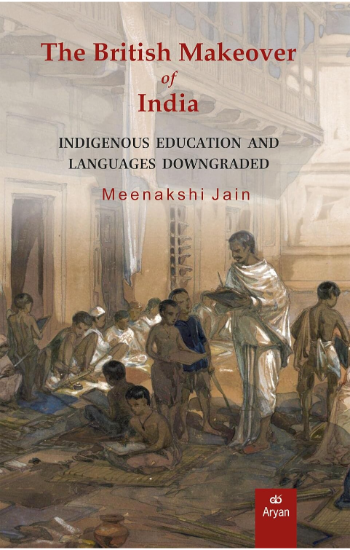
THE BRITISH MAKEOVER OF INDIA: Indigenous Education and Languages Downgraded

Publisher:
Aryan Books International
| Author:
Meenakshi Jain
| Language:
English
| Format:
Hardback
Publisher:
Aryan Books International
Author:
Meenakshi Jain
Language:
English
Format:
Hardback

Original price was: ₹995.Current price is: ₹796.

In stock

Ships within:
7-10 Days

In stock

ISBN:
Category:
Page Extent:
408

Long centuries before the Common Era, the commitment, continuity, and participation in the transmission of indigenous knowledge was apparent from several sources. An early important agency for the communication of literal and specialized education was the family. There were also references to teachers of noble character, gurus, who imparted knowledge in their ashrams. Later, the presence of organized institutions could be gleaned from temple colleges and mathas of acharyas.

At the beginning of the nineteenth century, indigenous systems of education were in a reasonably good state. British educational surveys, beginning with that of the Madras Presidency under the direction of Governor Thomas Munro, confirmed that. The colonial state made systematic attempts to undermine the self-sufficient indigenous education systems. Interestingly, a blueprint for the Christianization and Anglicization of India was presented as early as 1792 by the Evangelical, Charles Grant. Thomas B. Macaulay implemented the scheme some four decades later.

While most Company officials in India emphasized the need to retain indigenous vernacular systems, a small group in London and Calcutta pressed for English education. Complicating matters was the growing presence of missionaries, and their determination to proselytize. The Indian resistance to the blandishments of the Company and missionaries was the true story of education in colonial times.

Alongside was the battle against Persian and Urdu by proponents of Hindi, who regarded it as the bearer of indigenous cultural heritage. They viewed the promotion of Persian and Urdu as “the total displacement of the national and traditional for one which is strange, foreign, and uncongenial.”
Reviews

There are no reviews yet.

Be the first to review “THE BRITISH MAKEOVER OF INDIA: Indigenous Education and Languages Downgraded”

Your email address will not be published. Required fields are marked *

Description

Long centuries before the Common Era, the commitment, continuity, and participation in the transmission of indigenous knowledge was apparent from several sources. An early important agency for the communication of literal and specialized education was the family. There were also references to teachers of noble character, gurus, who imparted knowledge in their ashrams. Later, the presence of organized institutions could be gleaned from temple colleges and mathas of acharyas.

At the beginning of the nineteenth century, indigenous systems of education were in a reasonably good state. British educational surveys, beginning with that of the Madras Presidency under the direction of Governor Thomas Munro, confirmed that. The colonial state made systematic attempts to undermine the self-sufficient indigenous education systems. Interestingly, a blueprint for the Christianization and Anglicization of India was presented as early as 1792 by the Evangelical, Charles Grant. Thomas B. Macaulay implemented the scheme some four decades later.

While most Company officials in India emphasized the need to retain indigenous vernacular systems, a small group in London and Calcutta pressed for English education. Complicating matters was the growing presence of missionaries, and their determination to proselytize. The Indian resistance to the blandishments of the Company and missionaries was the true story of education in colonial times.

Alongside was the battle against Persian and Urdu by proponents of Hindi, who regarded it as the bearer of indigenous cultural heritage. They viewed the promotion of Persian and Urdu as “the total displacement of the national and traditional for one which is strange, foreign, and uncongenial.”

About Author

Meenakshi Jain is a historian interested in cultural and religious developments in Indian history. In 2020, she was awarded Padma Sri by the Government of India for her contributions in the field of literature and education. Her recent publications include – The British Makeover of India: Judicial and Other Indigenous Institutions Upturned(2024); Vishwanath Rises and Rises: The Story of Eternal Kashi (2024); The Hindus of Hindustan (2023); Vasudeva Krishna and Mathura (2021); Flight of Deities and Rebirth of Temples (2019); The Battle for Rama: Case of the Temple at Ayodhya (2017); Sati: Evangelicals, Baptist Missionaries, and the Changing Colonial Discourse (2016); and Rama and Ayodhya (2013).

Reviews

There are no reviews yet.

Be the first to review “THE BRITISH MAKEOVER OF INDIA: Indigenous Education and Languages Downgraded”

Your email address will not be published. Required fields are marked *

[wt-related-products product_id="test001"]

RELATED PRODUCTS

RECENTLY VIEWED