Two Sisters
Publisher:
| Author:
| Language:
| Format:
Publisher:
Author:
Language:
Format:
₹150 Original price was: ₹150.₹149Current price is: ₹149.
In stock
Ships within:
In stock
ISBN:
Page Extent:
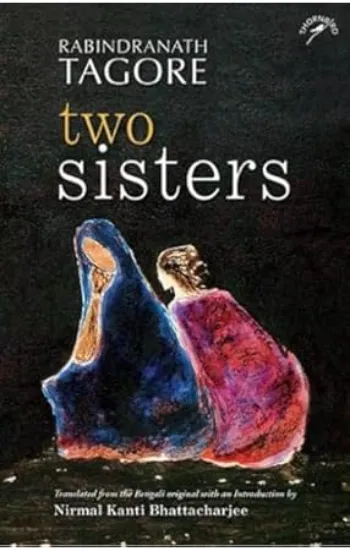
The eternal conflict in the age-old ‘man-woman’ relationship, which typically arises when any one of the two partners seeks both solace and passion in a single partner and is often unable to savour the joys of both together, is the central theme of Two Sisters (Dui Bon by Rabindranath Tagore, 1933). The central character Shashanka, is torn between two women, undecided between his homemaker wife Sharmila and her younger sister, the vivacious and playful Urmimala, who abhors domesticaiton.
The two women revolve round their common love interest and are overwhelmed by the intensity of desire, guilt and agony, in an endless cycle of happy conjugality giving way to the blinding intoxication of passion, finally leaving a toxic taste in the mouths of all the protagonists. The longing for a doting ‘mother’ to take care of all his needs often remains strong in a man smitten by a woman and desirous of her favours. Contemporary society is not devoid of this trait and this novella is thus universal and timeless in its approach.

The eternal conflict in the age-old ‘man-woman’ relationship, which typically arises when any one of the two partners seeks both solace and passion in a single partner and is often unable to savour the joys of both together, is the central theme of Two Sisters (Dui Bon by Rabindranath Tagore, 1933). The central character Shashanka, is torn between two women, undecided between his homemaker wife Sharmila and her younger sister, the vivacious and playful Urmimala, who abhors domesticaiton.
The two women revolve round their common love interest and are overwhelmed by the intensity of desire, guilt and agony, in an endless cycle of happy conjugality giving way to the blinding intoxication of passion, finally leaving a toxic taste in the mouths of all the protagonists. The longing for a doting ‘mother’ to take care of all his needs often remains strong in a man smitten by a woman and desirous of her favours. Contemporary society is not devoid of this trait and this novella is thus universal and timeless in its approach.
About Author
Tagore's poetic songs were viewed as spiritual and mercurial; however, his "elegant prose and magical poetry" remain largely unknown outside Bengal.[8] He is sometimes referred to as "the Bard of Bengal. Translator: Former Director, National Book Trust, India, and former Director, K.K. Birla Foundation, New Delhi, Nirmal Kanti Bhattacharjee was also the Editor of Sahitya Akademi’s prestigious journal Indian Literature.
Reviews
There are no reviews yet.

Reviews
There are no reviews yet.