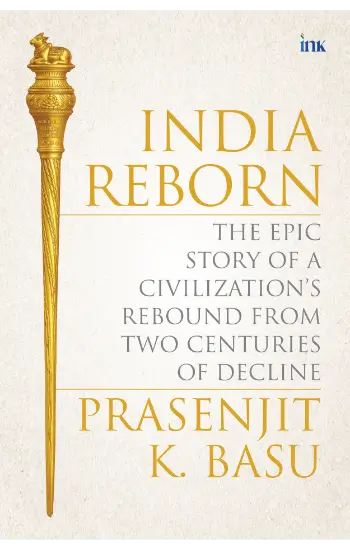
India Reborn : The Epic Story of a Civilization's Rebound from Two Centuries of Decline
Publisher:
| Author:
| Language:
| Format:
Publisher:
Author:
Language:
Format:
₹999 Original price was: ₹999.₹899Current price is: ₹899.
In stock
Ships within:
In stock
ISBN:
Page Extent:
India Reborn is a global history of the precipitous relative economic decline between 1757 and 1990 of the world’s oldest surviving civilization, the rejuvenation that began under Rao, and how Modi’s moral regeneration can restore India’s civilizational state to its rightful place as the world’s most consequential political economy.
It demonstrates that the revolutionary freedom struggle was more crucial than its nonviolent strand in obliging Britain to surrender its empire, revealing how the loot from India financed Britain’s industrialization, the Iran-Iraq logic of why India was partitioned, and the socioeconomic repercussions of Anglophilia on today’s India.
Gandhi’s better-known nonviolent mobilization was repeatedly crushed. But 1858’s independence war ended Company rule, 1905–11 obliged the rescinding of Bengal’s
partition, 1919 brought the Rowlatt Act betraying Montague’s 1917 promise of self-determination, and the INA-inspired military mutinies of 1946 obliged the end of Britain’s empire.
India did too little to change the economic status quo between 1947 and 1990, or to build on India’s strategic heritage. Outsiders to the Anglicized elite (Shastri, Vajpayee, Rao, Modi) led democratizing economic reforms and gave strategy a spine. Modi’s vast expansion of sanitation and financial inclusion advanced that transformation, but implementing labour market reform is vital to completing it, thereby ushering in Japan/Taiwan/RoK-style inclusive prosperity.

India Reborn is a global history of the precipitous relative economic decline between 1757 and 1990 of the world’s oldest surviving civilization, the rejuvenation that began under Rao, and how Modi’s moral regeneration can restore India’s civilizational state to its rightful place as the world’s most consequential political economy.
It demonstrates that the revolutionary freedom struggle was more crucial than its nonviolent strand in obliging Britain to surrender its empire, revealing how the loot from India financed Britain’s industrialization, the Iran-Iraq logic of why India was partitioned, and the socioeconomic repercussions of Anglophilia on today’s India.
Gandhi’s better-known nonviolent mobilization was repeatedly crushed. But 1858’s independence war ended Company rule, 1905–11 obliged the rescinding of Bengal’s
partition, 1919 brought the Rowlatt Act betraying Montague’s 1917 promise of self-determination, and the INA-inspired military mutinies of 1946 obliged the end of Britain’s empire.
India did too little to change the economic status quo between 1947 and 1990, or to build on India’s strategic heritage. Outsiders to the Anglicized elite (Shastri, Vajpayee, Rao, Modi) led democratizing economic reforms and gave strategy a spine. Modi’s vast expansion of sanitation and financial inclusion advanced that transformation, but implementing labour market reform is vital to completing it, thereby ushering in Japan/Taiwan/RoK-style inclusive prosperity.
About Author
Reviews
There are no reviews yet.

Reviews
There are no reviews yet.